Are We Alone? Life in the Universe
articles & documents
Advanced Aliens: Why ET Will Be More Advanced than Humanity
Seth Shostak, Senior Astronomer, SETI
Any beings capable of bridging the vast distances between the stars would be able to clean our clock when it comes to science and engineering. Visitors from other worlds – should any appear – would be enormously ahead of us from a technological viewpoint. It may surprise you to learn that the same is true for any aliens we might tune in with our SETI experiments. R
Advances in our Understanding of Life
Jack D. Farmer, NASA, 2001
Over the past two decades, advances in a number of scientific disciplines have helped us better understand the nature and evolution of life on Earth. These scientific developments also have helped lay the foundation for astrobiology, opening up new possibilities for the existence of life in the Solar System and beyond. R
Alien Intelligence? Think Again
Guillermo Gonzalez, Space.com, 29 February 2000
Skeptical article on ET intelligence. "The existence of extraterrestrial intelligence (ETI) has been debated since the ancient Greeks. Over the last few decades, both intellectual and public opinion have been decisively in the pro-ETI camp. Unfortunately, the debate has taken place on a very slanted playing field, at least in the United States." R
Alien life: Would we recognize it at all?
Seattle Times, January 8, 2003
Hundreds of astronomers yesterday learned that life in outer space is likely to lack green eyes and be far more prosaic, tiny and, quite possibly, completely unlike life as we know it. This blunt appraisal came from the University of Washington's Center for Astrobiology and Early Evolution, one of the first programs in the country to give an advanced degree in astrobiology. R
Alien Life? Astronomers Predict Contact by 2025
Hillary Mayell, National Geographic News, November 14, 2003
Earthlings could make contact with extraterrestrial beings by the year 2025, two astronomers predict in a new book. The authors say it's unlikely space aliens look like Hollywood's ET—little, green, and hairless—and that while aliens are highly unlikely to pay Earth a visit, they may be sending radio signals across space to let us know they exist. R
Are We Alone? Where are our Nearest Neighbors?
Edward Weiler, NASA Astrobiology Institute, August 6, 2001
Edward Weiler, NASA's Associate Administrator for Space Science discusses the search for life in the Universe. Are we alone? R
Defining Life
By Leslie Mullen, Astrobiology Magazine, Jun 19, 2002
What is life, exactly? This is a question that keeps biologists up at night. The science of biology is the study of life, yet scientists can't agree on an absolute definition. What about a computer program that learns and evolves? Can a wild fire - which feeds, grows, and reproduces - be considered a living entity? R
Drake Equation Naeye Sayer
Terence Dickinson, The Sunday Toronto Star, Dec. 7, 2003
In 1961, American astronomer Frank Drake developed his famous equation for estimating the number of technologically advanced civilizations in the galaxy. However, more and more scientists are having their doubts about the optimistic numbers and a substantial number of researchers consider the equation as obsolete as a black and white television from the '60s. R
Exotic Earths
David Lamb, NASA Astrobiology Institute
New astronomical techniques are vastly increasing what we know about extrasolar planets. Scientists have already found a large number of Jupiter sized bodies, but what about Earth-like planets in other solar systems? R
Galactic Habitable Zones
Leslie Mullen, Science Communications, NASA Astrobiology Institute, May 18, 2001
Our Milky Way Galaxy is unusual in that it is one of the most massive galaxies in the nearby universe. Our Solar System also seems to have qualities that make it rather unique. According to Guillermo Gonzalez, Assistant Professor of Astronomy at the University of Washington, these qualities make the Sun one of the few stars in the Galaxy capable of supporting complex life. R
How Far is ET?
Seth Shostak, Special to Space.com
How many light-years is it to the nearest alien civilization? In 1960, when Frank Drake made the first modern effort to eavesdrop on radio signals from ET, he trained his antenna on two relatively close stars, Epsilon Eridani and Tau Ceti: respectively 10 and 12 light-years from Earth. He picked these backyard buddies for several reasons. R
Pros and Cons of Life Existing Elsewhere
Dennis Balthaser, 07/01/00
I recently wrote an editorial entitled "Are We Alone?" and decided maybe I should follow it up with a similar editorial, since the question of life elsewhere in our universe continues to plague us. For honesty purposes, this editorial will probably be somewhat biased, because as a UFO researcher, I think the possibilities are overwhelming in favor of life elsewhere. In fairness, I will try (using others thoughts), to give a "for" and "against" view on the subject. R
Rare Earth Debate Part 1: The Hostile Universe
Space.com, July 2002
When the book "Rare Earth" was published two years ago, it raised a great deal of controversy among astrobiologists. Written by Peter Ward and Donald Brownlee, the book's hypothesis suggests complex life is rare in the universe, and may even be unique to Earth. This debate, a 5-part series, will cover a variety of topics prompted by the Rare Earth hypothesis. R
Rare Earth Debate Part 2: Alien Proximity
Space.com, July 2002
This five-part debate will cover a variety of topics prompted by the hypothesis of "Rare Earth," a book by Peter Ward and Donald Brownlee that suggests complex life may be unique to Earth. The focus on microbial life continues today in Part 2 as the moderator asks where we can expect to find life in our solar system and beyond. R
Rare Earth Debate Part 3: Complex Life
Space.com, July 2002
This five-part debate will cover a variety of topics prompted by the hypothesis of "Rare Earth," a book by Peter Ward and Donald Brownlee that suggests complex life may be unique to Earth. Today the participants examine complex life and the possibility of its occurrence in the universe. Complex life is generally considered any living thing with multiple cells -- as opposed to single celled, microbial life -- and, on Earth anyway, includes everything from the simplest slime molds to human beings. R
Rare Earth Debate Part 5: Elusive ET
Space.com, July 2002
This five-part debate has covered a variety of topics prompted by the hypothesis of "Rare Earth," a book by Peter Ward and Donald Brownlee that suggests complex life may be unique to Earth. Today in the final installment the participants examine why we haven’t found complex intelligent life, if indeed it does exist elsewhere in the universe. A thread of this debate also picks up on a comment made by Donald Brownlee in Part 4 -- that interstellar space travel may be impossible. R
Signs of Life: On the Lookout for Extraterrestrial Sweet Spots
Leonard David, SPACE.com, 03 January 2002
Looking for life elsewhere is a tough task for human or robot. The good news is that the scientific skill and tools to search for, detect and inspect extraterrestrial life are advancing rapidly. R
Skepticism With Wonder
Carol Oliver, Australian Centre for Astrobiology, interview in Astrobiology Magazine
The challenge to communicate both the breadth and depth of astrobiology is discussed by Carol Oliver, of the Australian Centre for Astrobiology. As a researcher in communicating science, she considers how best to tell a busy public what it means to explore other worlds for signs of life elsewhere. R
The Galactic Civilizations: Part V
Astrobiology Magazine
This is the fifth and final part of a series of presentations given at a public forum sponsored by the NASA exobiology branch. The forum, held in Palo Alto, CA, on Tuesday, August 26, 2003, was entitled, "The Drake Equation Revisited." This installment addresses the evolution of machine intelligence and the potential for civilizations that span the galaxy. R
The Meaning of Life
Lee Siegel, NASA Astrobiology Institute, July 6, 2001
Sitting beneath a dark night sky, looking up at the vast array of stars, what human has not wondered, "Are we alone?" R
The Search for Life in the Universe
Neil deGrasse Tyson, to the House Subcommitee on Space and Aeronautics
Neil deGrasse Tyson discusses the search for life in the Universe. Are we alone? R
The Unexplored Cosmos
Ann Druyan and Steven Soter, interview in Astrobiology Magazine
Cosmos collaborators, Ann Druyan (widow of Carl Sagan) and astrophysicist Steven Soter, talk about the possiblities for finding life elsewhere and the implications for understanding humanity's own place in the universe. R
Time Enough for Life
Peter Backus, SETI Institute, on Space.com, 16 October 2003
In our hectic world, we seldom have time enough for life: time for family, time for friends, or time for the pleasures of life. In studying the universe, Astrobiologists face a different problem: which stars might provide time enough for life? The answer depends on the life of the star. R
websites & organizations
NASA Astrobiology Institute
Astrobiology is devoted to the scientific study of life in the universe - its origin, evolution, distribution, and future. In 1998 NASA established the NASA Astrobiology Institute (NAI) as one element of its research program in astrobiology.
books
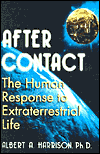 After Contact: The Human Response to Extraterrestrial Life Albert A. HarrisonAlbert Harrison examines in detail the psychological, sociological, political, and cultural dimensions of the search for extraterrestrial intelligence. By so doing, he firmly establishes that the behavioral and social sciences are as integral to the search as are the physical and biological sciences that have dominated the field up to now. This book offers a useful conceptual framework for rational discussion of extraterrestrial life forms, and provides a detailed analysis of likely human reactions to the detection of extraterrestrial life.
Buy from Amazon
Buy from Barnes & Noble
more info...
After Contact: The Human Response to Extraterrestrial Life Albert A. HarrisonAlbert Harrison examines in detail the psychological, sociological, political, and cultural dimensions of the search for extraterrestrial intelligence. By so doing, he firmly establishes that the behavioral and social sciences are as integral to the search as are the physical and biological sciences that have dominated the field up to now. This book offers a useful conceptual framework for rational discussion of extraterrestrial life forms, and provides a detailed analysis of likely human reactions to the detection of extraterrestrial life.
Buy from Amazon
Buy from Barnes & Noble
more info...
 Alien Life: The Search for Extraterrestrials and Beyond Barry ParkerParker (physics and astronomy, Idaho State U.) surveys all the popular topics in the aliens craze, giving an overview of the subject and discussing the work of numerous scientists, science fiction writers, psychologists, and theorists. He discusses the development of life on our planet, the possibility of microbial life on Mars, life on other planets and moons in the solar system, life on planets outside of our solar system and what form their civilizations might take, SETI, UFOs, and our future exploration of the universe.
Buy from Amazon
Buy from Barnes & Noble
more info...
Alien Life: The Search for Extraterrestrials and Beyond Barry ParkerParker (physics and astronomy, Idaho State U.) surveys all the popular topics in the aliens craze, giving an overview of the subject and discussing the work of numerous scientists, science fiction writers, psychologists, and theorists. He discusses the development of life on our planet, the possibility of microbial life on Mars, life on other planets and moons in the solar system, life on planets outside of our solar system and what form their civilizations might take, SETI, UFOs, and our future exploration of the universe.
Buy from Amazon
Buy from Barnes & Noble
more info...
 Are We Alone? Philosophical Implications of the Discovery of Extraterrestrial Life Paul C. W. DaviesWhat must we assume about the laws of physics, the nature of the universe, and the nature of life and intelligence in order to expect that there is intelligent life out there? And if there is, what would it do to our science, our religions, and our world view in general? Are We Alone? ponders the enormous implications for such major philosophical and religious issues as the mind-body problem, the nature of life and consciousness, and the place of mankind in the cosmos.
Buy from Amazon
Buy from Barnes & Noble
more info...
Are We Alone? Philosophical Implications of the Discovery of Extraterrestrial Life Paul C. W. DaviesWhat must we assume about the laws of physics, the nature of the universe, and the nature of life and intelligence in order to expect that there is intelligent life out there? And if there is, what would it do to our science, our religions, and our world view in general? Are We Alone? ponders the enormous implications for such major philosophical and religious issues as the mind-body problem, the nature of life and consciousness, and the place of mankind in the cosmos.
Buy from Amazon
Buy from Barnes & Noble
more info...
 Astrobiology
Monica M. GradyGrady (head of petrology and meteoritics at The Natural History Museum) provides a general reader's introduction to a relatively old area of inquiry—whether and where there is life elsewhere in the universe. Using dozens of large color photos and diagrams, she describes how life evolved on Earth, the likeliness of life in other parts of the solar system, the search for Earth-like planets, and SETI.
Buy from Amazon
Buy from Barnes & Noble
more info...
Astrobiology
Monica M. GradyGrady (head of petrology and meteoritics at The Natural History Museum) provides a general reader's introduction to a relatively old area of inquiry—whether and where there is life elsewhere in the universe. Using dozens of large color photos and diagrams, she describes how life evolved on Earth, the likeliness of life in other parts of the solar system, the search for Earth-like planets, and SETI.
Buy from Amazon
Buy from Barnes & Noble
more info...
 Cosmic Company: The Search for Life in the Universe
Seth Shostak, Alexandra BarnettIn Cosmic Company, Seth Shostak and Alex Barnett ponder the possibility of aliens visiting the Earth, as well as the consequences of receiving a signal from the cosmos proving we're neither alone, nor the most intelligent life forms. They explain why scientists think life might exist on other worlds, and how we might contact it. Shostak and Barnett, experienced writers of popular astronomy, provide an accessible overveiw of the science and technology behind the search for life in the universe.
Buy from Amazon
Buy from Barnes & Noble
more info...
Cosmic Company: The Search for Life in the Universe
Seth Shostak, Alexandra BarnettIn Cosmic Company, Seth Shostak and Alex Barnett ponder the possibility of aliens visiting the Earth, as well as the consequences of receiving a signal from the cosmos proving we're neither alone, nor the most intelligent life forms. They explain why scientists think life might exist on other worlds, and how we might contact it. Shostak and Barnett, experienced writers of popular astronomy, provide an accessible overveiw of the science and technology behind the search for life in the universe.
Buy from Amazon
Buy from Barnes & Noble
more info...
 Here Be Dragons: The Scientific Quest for Extraterrestrial Life David W. Koerner, Simon LeVayIn Here Be Dragons, astronomer David Koerner and neurobiologist Simon LeVay offer a scientifically compelling and colorful account of the search for life beyond Earth." "The authors survey the work of biologists, cosmologists, computer theorists, NASA engineers, SETI researchers, roboticists, and UFO enthusiasts and debunkers as they attempt to answer the greatest remaining question facing humankind: Are we alone? Arguing that the universe is spectacularly suited for the evolution of living creatures, Koerner and LeVay give us ringside seats at the great debates of Big Science.
Buy from Amazon
Buy from Barnes & Noble
more info...
Here Be Dragons: The Scientific Quest for Extraterrestrial Life David W. Koerner, Simon LeVayIn Here Be Dragons, astronomer David Koerner and neurobiologist Simon LeVay offer a scientifically compelling and colorful account of the search for life beyond Earth." "The authors survey the work of biologists, cosmologists, computer theorists, NASA engineers, SETI researchers, roboticists, and UFO enthusiasts and debunkers as they attempt to answer the greatest remaining question facing humankind: Are we alone? Arguing that the universe is spectacularly suited for the evolution of living creatures, Koerner and LeVay give us ringside seats at the great debates of Big Science.
Buy from Amazon
Buy from Barnes & Noble
more info...
 Life Everywhere: The Maverick Science of Astrobiology David DarlingAstrobiology (also known as exobiology) has been rapidly gaining ground in recent years as new research points to the ever increasing likelihood of life in the universe. David Darling's excellent introduction to this subject covers the new discoveries, such as extremophile life forms and extrasolar planets, that make it more possible for life to exist beyond Earth and explores astonishing speculations, such as the one that life may have actually originated in outer space.
Buy from Amazon
Buy from Barnes & Noble
more info...
Life Everywhere: The Maverick Science of Astrobiology David DarlingAstrobiology (also known as exobiology) has been rapidly gaining ground in recent years as new research points to the ever increasing likelihood of life in the universe. David Darling's excellent introduction to this subject covers the new discoveries, such as extremophile life forms and extrasolar planets, that make it more possible for life to exist beyond Earth and explores astonishing speculations, such as the one that life may have actually originated in outer space.
Buy from Amazon
Buy from Barnes & Noble
more info...
 Life on Other Worlds: The 20th-Century Extraterrestrial Life Debate Steven J. DickDick, an astronomer and historian of science at the US Naval Observatory, offers an antidote to the sensationalism surrounding the search for extraterrestrial life in this overview of the history of theories of life on other planets, recent advances in planetary science, and the latest thinking on the likelihood of life in outer space. He also demystifies the agenda of sensationalists who seek to impose their own radical cosmology based on conjecture rather than scientific fact.
Buy from Amazon
Buy from Barnes & Noble
more info...
Life on Other Worlds: The 20th-Century Extraterrestrial Life Debate Steven J. DickDick, an astronomer and historian of science at the US Naval Observatory, offers an antidote to the sensationalism surrounding the search for extraterrestrial life in this overview of the history of theories of life on other planets, recent advances in planetary science, and the latest thinking on the likelihood of life in outer space. He also demystifies the agenda of sensationalists who seek to impose their own radical cosmology based on conjecture rather than scientific fact.
Buy from Amazon
Buy from Barnes & Noble
more info...
 Many Worlds: The New Universe, Extraterrestrial Life, and the Theological Implications Steven J. DickAn eminent cast of scientists and science-and-religion writers is ultimately unable to achieve the loosely conceived goal of this conference volume: to discuss the theological implications of cosmic evolution and the possibility of extraterrestrial life and intelligence. Most essays read like opening statements rather than genuine dialogue. Readers may easily become disoriented by elliptical discussions of "the astounding facts of the new universe" while sifting through radically different portrayals of what science says about cosmic origins and biogenesis.
Buy from Amazon
Buy from Barnes & Noble
more info...
Many Worlds: The New Universe, Extraterrestrial Life, and the Theological Implications Steven J. DickAn eminent cast of scientists and science-and-religion writers is ultimately unable to achieve the loosely conceived goal of this conference volume: to discuss the theological implications of cosmic evolution and the possibility of extraterrestrial life and intelligence. Most essays read like opening statements rather than genuine dialogue. Readers may easily become disoriented by elliptical discussions of "the astounding facts of the new universe" while sifting through radically different portrayals of what science says about cosmic origins and biogenesis.
Buy from Amazon
Buy from Barnes & Noble
more info...
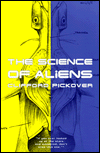 Science of Aliens Clifford A. PickoverWhat would aliens look like? An intelligent octopus-like creature is certainly plausible. What about odd numbers of limbs - a three-legged alien with three arms and three eyes? Could there be an entire planet of immobile, silicon-based "trees" that communicate with each other via electrical signals? The Science of Aliens gets weirder still. Could a giant interstellar cloud be "alive" and intelligent? Could creatures live at extremely high pressures and temperatures? Would they have any interest in abducting us? In classic Pickover style, here is scientifically based speculation at the far edge of knowledge-and beyond.
Buy from Amazon
Buy from Barnes & Noble
more info...
Science of Aliens Clifford A. PickoverWhat would aliens look like? An intelligent octopus-like creature is certainly plausible. What about odd numbers of limbs - a three-legged alien with three arms and three eyes? Could there be an entire planet of immobile, silicon-based "trees" that communicate with each other via electrical signals? The Science of Aliens gets weirder still. Could a giant interstellar cloud be "alive" and intelligent? Could creatures live at extremely high pressures and temperatures? Would they have any interest in abducting us? In classic Pickover style, here is scientifically based speculation at the far edge of knowledge-and beyond.
Buy from Amazon
Buy from Barnes & Noble
more info...
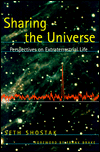 Sharing the Universe: Perspectives on Extraterrestrial Life Seth ShostakShostak is the Public Programs Scientist for the SETI (Search for Extraterrestrial Intelligence) Institute. In this fascinating speculative book, he builds a careful case for the importance of the institute's work, narrowing the range of the galaxy's possibly life-nurturing stars and imagining what forms non-carbon-based life might take.
Buy from Amazon
Buy from Barnes & Noble
more info...
Sharing the Universe: Perspectives on Extraterrestrial Life Seth ShostakShostak is the Public Programs Scientist for the SETI (Search for Extraterrestrial Intelligence) Institute. In this fascinating speculative book, he builds a careful case for the importance of the institute's work, narrowing the range of the galaxy's possibly life-nurturing stars and imagining what forms non-carbon-based life might take.
Buy from Amazon
Buy from Barnes & Noble
more info...
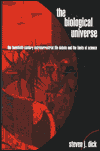 The Biological Universe : The Twentieth Century Extraterrestrial Life Debate and the Limits of Science
Steven J. DickThe Biological Universe provides a rich and colorful history of the attempts during the twentieth century to answer questions such as whether "biological law" reigns throughout the universe and whether there are other histories, religions, and philosophies outside those on Earth. Covering a broad range of topics, including the search for life in the solar system, the origins of life, UFOs, and aliens in science fiction, Steven J. Dick shows how the concept of extraterrestrial intelligence is a world view of its own, a "biophysical cosmology" that seeks confirmation no less than physical views of the universe.
Buy from Amazon
Buy from Barnes & Noble
more info...
The Biological Universe : The Twentieth Century Extraterrestrial Life Debate and the Limits of Science
Steven J. DickThe Biological Universe provides a rich and colorful history of the attempts during the twentieth century to answer questions such as whether "biological law" reigns throughout the universe and whether there are other histories, religions, and philosophies outside those on Earth. Covering a broad range of topics, including the search for life in the solar system, the origins of life, UFOs, and aliens in science fiction, Steven J. Dick shows how the concept of extraterrestrial intelligence is a world view of its own, a "biophysical cosmology" that seeks confirmation no less than physical views of the universe.
Buy from Amazon
Buy from Barnes & Noble
more info...
 The Extraterrestrial Life Debate, 1750-1900
Michael J. CroweThis is the first detailed, scholarly study in English of the many varied astronomical, philosophical and religious ideas that developed between 1750 and 1900 regarding the existence of intelligent extraterrestrial life. The author examines the great extent to which prominent historical figures (Kant, Herschel, Paine, Lowell, etc.) engaged the issue, and demonstrates the powerful effect the question has had on Western intellectual life.
Buy from Amazon
Buy from Barnes & Noble
more info...
The Extraterrestrial Life Debate, 1750-1900
Michael J. CroweThis is the first detailed, scholarly study in English of the many varied astronomical, philosophical and religious ideas that developed between 1750 and 1900 regarding the existence of intelligent extraterrestrial life. The author examines the great extent to which prominent historical figures (Kant, Herschel, Paine, Lowell, etc.) engaged the issue, and demonstrates the powerful effect the question has had on Western intellectual life.
Buy from Amazon
Buy from Barnes & Noble
more info...
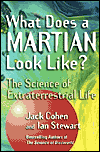 What Does a Martian Look Like?: The Science of Extraterrestrial Life Jack Cohen, Ian StewartIn What Does a Martian Look Like?, two respected scientists and authors combine real science with the creations of some of the world's most inventive science fiction writers to imagine how life may have evolved elsewhere in the universe. They show that the universe is not populated with countless variations on the humanoid form or horrifying creatures drawn from your worst nightmares. Instead, they demonstrate how universal principles of life might produce amazingly diverse outcomes when applied in different environments.
Buy from Amazon
Buy from Barnes & Noble
more info...
What Does a Martian Look Like?: The Science of Extraterrestrial Life Jack Cohen, Ian StewartIn What Does a Martian Look Like?, two respected scientists and authors combine real science with the creations of some of the world's most inventive science fiction writers to imagine how life may have evolved elsewhere in the universe. They show that the universe is not populated with countless variations on the humanoid form or horrifying creatures drawn from your worst nightmares. Instead, they demonstrate how universal principles of life might produce amazingly diverse outcomes when applied in different environments.
Buy from Amazon
Buy from Barnes & Noble
more info...
 Xtl: Extraterrestrial Life and How to Find It
Simon Goodwin, John GribbinAre we alone in the Universe? The best scientists are searching hard for the answer--and may be just around the corner from finding it. Two top astronomers (and bestselling authors) take a cutting-edge look at how life itself develops, survives, evolves, becomes intelligent, and where it might exist in outer space. Illustrated with breathtaking photos and state-of-the-art graphics, this thrilling story reveals a newfound understanding of the conditions that fostered life on Earth, how stars and planets are formed, the specific qualities of the Sun and planets in our solar system, and the techniques required to observe phenomena outside of our system. The fascinating advances in technology and information revealed here could enable us to locate extraterrestrials within the next twenty years!
Buy from Amazon
Buy from Barnes & Noble
more info...
Xtl: Extraterrestrial Life and How to Find It
Simon Goodwin, John GribbinAre we alone in the Universe? The best scientists are searching hard for the answer--and may be just around the corner from finding it. Two top astronomers (and bestselling authors) take a cutting-edge look at how life itself develops, survives, evolves, becomes intelligent, and where it might exist in outer space. Illustrated with breathtaking photos and state-of-the-art graphics, this thrilling story reveals a newfound understanding of the conditions that fostered life on Earth, how stars and planets are formed, the specific qualities of the Sun and planets in our solar system, and the techniques required to observe phenomena outside of our system. The fascinating advances in technology and information revealed here could enable us to locate extraterrestrials within the next twenty years!
Buy from Amazon
Buy from Barnes & Noble
more info...